Nasrettin Khoja
Nasreddin Hodja, one of the most important names in the history of humor, is also an unforgettable part of Turkish culture. Nasreddin Hodja is a legendary person who lived between 1208-1284. It is also loved by many people for its candid response and clever humor. Although some people think that Nasreddin Hodja is not real, there are also documents in historical sources that he was a real person.
history
Nasreddin Hodja, who was educated in Hortu, is an expert on many subjects. After receiving his basic education, he worked as a village imam. There are many funny articles and jokes allegedly by Nasreddin Hodja. These have been told all over the world over the years and have reached the present day. The written proof of Nasreddin Hodja is in the Saltukname, which was copyrighted in 1480. The anecdotes compiled from these works have also been examined in terms of the messages they contain, their contents and mythological effects. These works are also used in educational activities in schools. Beliefs such as burying newborn babies after their umbilical cords fall off or visiting the shrine by married couples come from Nasreddin Hodja stories. It is a very famous name among Arabs, Chinese, Turks, Persians and Russians. There are many works on Nasreddin Hodja all over the world. The most famous is Nasreddin Hodja’s Mansi, which was written between 1775 and 1782. 1996 is celebrated by UNESCO as the Year of Nasreddin Hodja all over the world. Nasreddin Hodja is commemorated by festivities and competitions on these days.
Vital
Nasreddin Hodja was born in 1208 in Hortu, Sivrihisr. At this time, Hortu was a place belonging to the Anatolian Seljuk State. His father is Abdullah Efendi, the imam of Hortu village, and his mother is Sıdıka Hatun, who lived in the same area. Nasreddin Hodja, who was educated in a madrasah in Sivrihisar, started to work as a village imam after his father’s death. Nasreddin Hodja, who settled in Akşehir in 1237 and listened to the lectures of Seyyd Mahmud Hayrani and Seyyid Hacı İbrahim there, became much more knowledgeable by doing many studies on the religion of Islam. Nasreddin Hodja, who taught and worked as a judge in madrasahs, was named Nasuriddin Hace because of these duties. Over time, this name changed and became Nasreddin Hodja. Nasreddin Hodja has also been found in cities such as Kayseri, Ankara, Afyonkarahisar and Kütahya. Being such a famous name has made him a legend. In some legends, it is stated that he met the Seljuk sultans and chatted with Timur, who would live after 70. Nasreddin Hodja died in his home in Akşehir in 1284.
Nasreddin Hodja’s tomb is in the Nasreddin Hodja Tomb. Nasreddin Hodja, who died in 1284, was first buried here, and then his tomb was turned into a tomb. The tomb, which was built during the first Anatolian Principalities, consists of two intertwined parts. In 1878, the top of the tomb was covered with a pyramid cone carried by 12 columns. The mausoleum, which was sometimes repaired as necessary, underwent a major repair in 1906 by Faik Bey, the governor of Konya. There is still an inscription in the tomb describing this repair. The descendants of Nasreddin Hodja were assigned to maintain the tomb. These people are exempted from taxes and are paid a salary. In addition to Nasreddin Hodja, there is also the tomb of Habibe, the daughter of Mehmed I, in the Nasreddin Hodja Tomb. The tomb is still open to visitors today. The tomb in Konya Akşehir is visited by many people.
What Makes Nasreddin Hodja Nasreddin Hodja?
Based on Nasreddin Hodja anecdotes, he is understood as a saint and a ready-made answer. It is the most important thing that does it himself. All of his jokes are jokes that include helping the poor and orphans and are based on tolerance. It says that all people are equal and that no one should be despised. During his lifetime, he became loved by everyone as he was a member of the public and stood by the unjust. Nasreddin Hodja, who is quite intelligent, influenced even the important names of his time with his ready response. Being ready to answer and giving deep meaningful answers to the questions asked is one of his most well-known features. No matter how simple and funny the jokes may seem, a basis must be sought under Nasreddin Hodja jokes and read assimilated. Every joke of the teacher is a life lesson.
One of the most important things that makes Nasreddin Hodja Nasrettin Hodja is the donkey in almost every joke. Nasreddin Hodja always comes to mind with his donkey. The donkey is actually an element of ridicule and satire. Anatolian people used donkeys more than horses because they were poor at that time. Horses were mostly found in the rich and in palaces. For this reason, you always come across a donkey in Nasreddin Hodja anecdotes. The donkey indicates pain, distress and hunger. There are contradictions in laughter. People are made to think by laughing. It is mentioned how much importance people give to substances in the “yes, i’m e fur” paragraph. The painful situation is explained to people in a funny way. Nasreddin Hodja’s thoughts and works influenced many people. In many regions, there are people who make jokes about Nasreddin Hodja. Nasreddin Hodja, who deals with everything that happens in the world, owes his fame to this. Everyone has the same problem in general. Errors and irregularities in societies can be easily corrected based on anecdotes. Nasreddin Hodja has a joke that is suitable for almost every subject and that you can definitely learn a lesson from. For many years, Turkish society has shaped the lives of Nasreddin Hodja with his works.
Presenting his critical point of view with humor made him a unique personality. Critical thinking and humor feed each other, so they cannot be considered separately. UNESCO has proven this and adopted Nasreddin Hodja as a universal value.
Nasreddin Hodja Jokes and Stories
Nasreddin Hodja has thousands of different jokes that have survived to the present day. The reason why these are so many is that they have been used and explained by many different societies until today. Nasreddin Hodja has certain patterns. The remaining ones do not belong to Nasreddin Hodja. First of all, there are no things that involve alcohol or drunkenness in Nasreddin Hodja anecdotes. Nasreddin Hodja, who is knowledgeable and interested in Islam, does not use this subject. Anecdotes that misrepresent the teacher are also not included in his works. Since Hodja has lived in poverty for years, he does not have anecdotes about wealth or wealth. Brute force and stinginess are also not compatible with it. Nasreddin Hodja has always advocated helping people and getting along with each other. For this reason, not everyone is a supporter. One of the most important features of Nasreddin Hodja jokes is that all his jokes are concise and concise. All of them contain messages that will be good for people. One of the biggest reasons why Nasreddin Hodja anecdotes have spread so much is the written tradition. The tradition of writing and keeping letters, which started in the 15th century, continued until the half of the 19th century. In 1850, Nasreddin Hodja compilations were printed for the first time in printing houses. The first illustrated collection of Nasreddin Hodja was made in Istanbul in 1864. The general contents of the anecdotes include the society’s non-compliance with the rules of religion, morality and custom and adapting them to the mind of the society. Emphasizing the general idea is the main purpose of Nasreddin Hodja works. Today, Nasreddin Hodja jokes and his works are used even for the youngest children. Empathy is one of the most important narratives.
All of Nasreddin Hodja’s works are based on real events. The reactions of people to these events and the events that took place are also told to others by participating in humor. Mihaz, on the other hand, is done with subjects such as vilifying and mocking. You can come across every daily event in Nasreddin Hodja anecdotes. The events in Nasreddin Hodja’s works are generally among the people. Hodja cannot communicate much with nobles and high people.
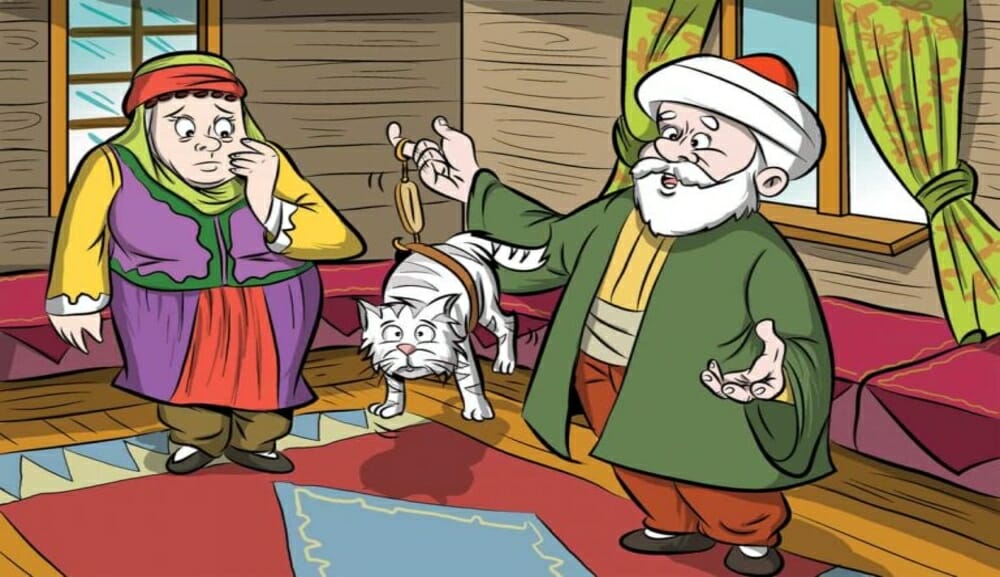
Responsiveness is one of the most important features of Nasreddin Hodja. This situation is found in almost every paragraph. Ye furüm ye clause is one of the best examples of this situation. In this joke, Nasreddin Hodja sees his neighbors going somewhere in a hurry while returning home. A neighbor passing by asks him if he will come to the feast. However, Nasreddin Hodja is unaware of the existence of such a feast. The teacher, immersed in work, completely forgot about the feast. He told his neighbor that he would come after he changed his clothes. After she got home, she wore a clean but somewhat old-fashioned outfit. The person who had a banquet in his house was one of the richest people in Akşehir. After the teacher got dressed, he went there and went inside. With the ringing of the dinner bell, the servants came and began to prepare the tables. However, no one took care of Nasreddin Hodja and gave him food because of his clothing. Seeing this, Nasreddin Hodja returned home and put on his fur. When he entered the banquet hall with his fur, everyone’s eyes suddenly turned to Nasreddin Hodja. Servants came in front of him and sat him down. Even the owner of the house came and greeted Nasreddin Hodja. Meals, pastries, desserts and drinks were served on its table. Nasreddin Hodja dipped one end of his fur into the food. This situation went to the strangest of everyone in the hall. On the other hand, Nasreddin Hodja says “eat my fur“. People asked the teacher why he did this. Nasreddin Hodja said, “You took care of me when my lurk came, and you took me among you, so I make my fur to eat.” Said.
This joke is one of the best jokes about how cruel and prejudiced people can be. Wealth and money are very important to many people. This causes people to forget what really matters. The main thing is to share everything and not look down on anyone. Nasreddin Hodja explains in this paragraph that people should not be looked down upon. Nasreddin Hodja, who can respond to every situation, showed his talent in this joke. There is a subtext in all of the jokes that come from the comic. In order to understand them, we need to have a certain knowledge and worldview. Nasreddin Hodja shows this to us in every paragraph. Even after hundreds of years, all of Nasreddin Hodja’s jokes are in harmony with the present. This means that people never change. What we have to do is to learn something from Nasreddin Hodja and continue our life in a more aware way.
Nasreddin Hodja gives important information about the things that hurt people the most and uses them in his jokes as an element of humor. When you read the jokes, you will definitely find a piece of your life. This shows how consistent the writing is. Nasreddin Hodja will always appear before us as a treasure that is important and famous all over the world. His works reach people in many languages.