
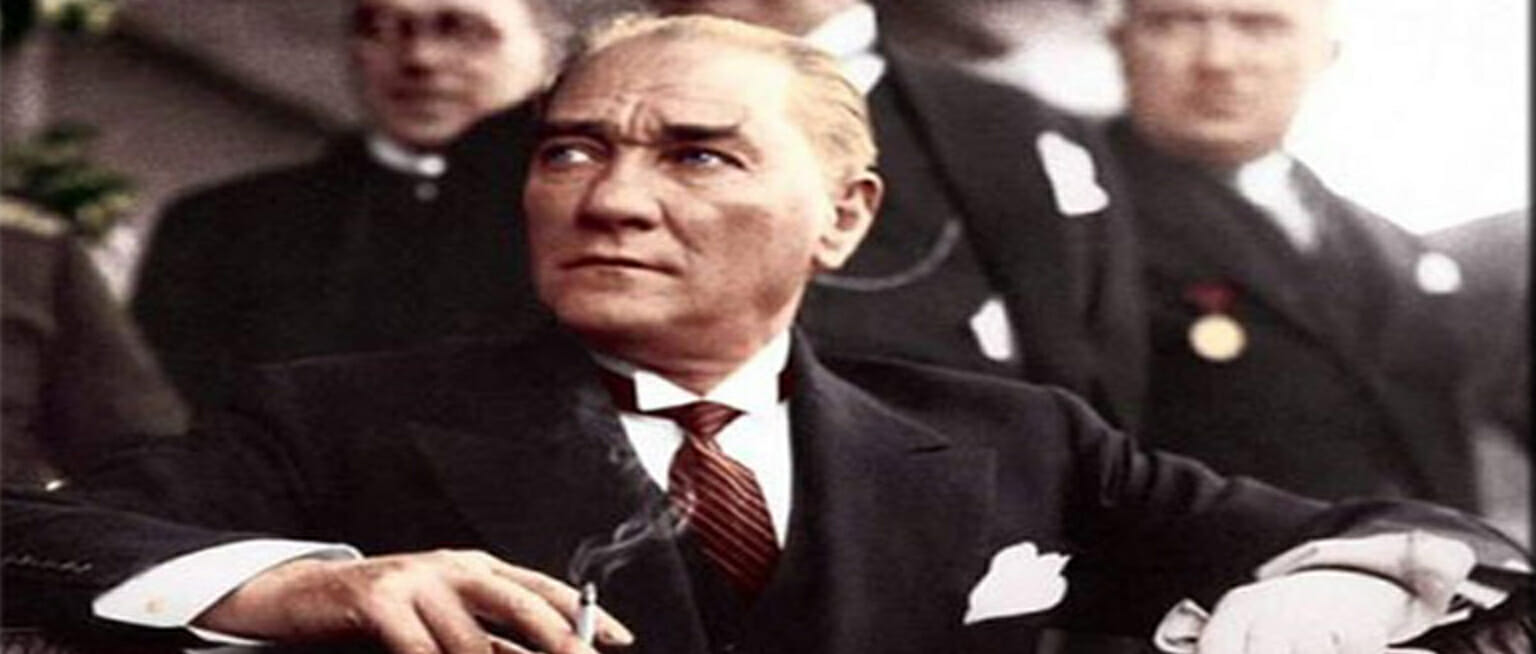
"If one day my words contradict science, choose science."
ATATURK
MUSTAFA KEMAL ATATURK
Being Mustafa Kemal
Atatürk, the greatest figure who lived in the 20th century, is the common symbol of struggle, enlightenment and most importantly independence, which has been an inspiration for all leaders who have lost hope in the world and drawn a road map for all colonized peoples in the era when one of the strongest periods of fascism and colonialism in the world.
His life (1881-1938)
First 24 Years of Your Life
He was born in Thessaloniki in 1881. His father is Ali Rıza Efendi and his mother is Zübeyde Hanım. Ali Rıza Efendi married Zübeyde Hanım in 1871. Four of Atatürk’s five siblings died at a young age, only Makbule (Atadan) Hanım lived until 1956.
He started his primary education in the neighborhood school of Hafız Mehmet Efendi. After a short time, at the request of his father, he transferred to Şemsi Efendi School, which provides modern education. Meanwhile, he lost his father. He finished his school and enrolled in Thessaloniki Mulkiye High School. In 1893, he entered Thessaloniki Military High School. He took the name “Kemal” from his mathematics teacher, Captain Mustafa Efendi. Thus, his name became “Mustafa Kemal”. After graduating from Thessaloniki Military High School, he started the Manastır Military High School in 1896. He graduated from the Manastır Military High School in 1896-1899 and was enrolled in the infantry class of the Military Academy in Istanbul. Together with his friends, he secretly published a hand-printed newspaper in order to spread the ideas of freedom. He graduated from the Military Academy with the rank of lieutenant in 1902 and entered the Military Academy. In 1903, he moved to the second class and was promoted to first lieutenant. He graduated from the Military Academy with the rank of captain on January 11, 1905.
Mustafa Kemal’s Military Years
After his graduation, he was detained for a short time due to his anti-government ideas. In 1905, he was appointed to the 5th Army in Damascus. Together with some of his friends, he secretly founded the Vatan ve Hürriyet Cemiyeti. Branches of this society were opened in Beirut, Jaffa and Jerusalem. He received the rank of Kolağası (Senior Captain) in 1907.
He was sent to Tripoli to prevent the reactions that followed the declaration of the Constitutional Monarchy. After removing the unrest there, he returned to Thessaloniki in January 1909. He was appointed as the Chief of Staff of the 3rd Army Thessaloniki 2nd Redif Division. Upon the outbreak of the rebellion, which went down in history as the 31 March Incident, he moved from Thessaloniki to Istanbul on April 15-16, 1909. He voluntarily participated in the Tripoli War in 1911. He was promoted to the rank of Major. When the Balkan War started in October 1912, Mustafa Kemal joined the war with the troops in Gallipoli and Bolayır. He took Edirne back from the Bulgarians on 21 July 1913. He was promoted to the rank of lieutenant colonel in 1914. In the First World War, he wrote a heroic epic in Çanakkale and said to the Entente states, “Canakkale is impassable!” he said.
On March 18, 1915, when the British and French navies, trying to cross the Dardanelles, suffered heavy losses, it was decided to land troops on the Gallipoli Peninsula. The 19th Division commanded by Mustafa Kemal stopped the enemy forces that landed on Arıburnu on April 25, 1915 at Conkbayırı. Upon this success, Mustafa Kemal was promoted to the rank of colonel. The British attacked again at Arıburnu on 6-7 August 1915. Anafartalar Group Commander Mustafa Kemal won the Anafartalar Victory on August 9-10. This victory was followed by Kireçtepe victories on 17 August and the second Anafartalar victories on 21 August. Mustafa Kemal told his soldiers, “I am not ordering you to attack, I am ordering you to die!” His order changed the fate of the front. He was appointed as the Commander of the 16th Corps, which was transferred from Çanakkale to Edirne in 1916. After the Caucasian Front gained importance, Mustafa Kemal took office in Diyarbakir. He was promoted to major general on April 1, 1916.
He fought the Russian forces and ensured the recapture of Muş and Bitlis. He was appointed as the Commander of the Yıldırım Army Group on October 31, 1918. He went to Samsun on 19 May 1919 as the 9th Army Inspector. With the circular published in Amasya on June 22, 1919, he declared that “the independence of the nation will be saved by the determination and decision of the nation” and called the Sivas Congress to a meeting. He convened the Erzurum Congress between 23 July and 7 August 1919, and the Sivas Congress between 4-11 September 1919, and determined the path to be followed for the liberation of the homeland. He was greeted enthusiastically in Ankara on 27 December 1919. With the opening of the Turkish Grand National Assembly on April 23, 1920, an important step was taken towards the establishment of the Republic of Turkey. Mustafa Kemal was elected as the Chairman of the Assembly and the Government. The Turkish Grand National Assembly adopted and started to implement the necessary laws for the successful conclusion of the War of Independence. The Turkish War of Independence began on May 15, 1919, when the first bullet was fired at the enemy during the Greek occupation of Izmir. First, the militia forces called Kuvayi Milliye were fought against the victorious states of the First World War. The Grand National Assembly of Turkey established the regular army, ensured the integration of the Kuvayi Milliye and the army, and ended the war with victory.
The important stages of the Turkish War of Independence under Mustafa Kemal are as follows:
- The liberation of Sarıkamış (20 September 1920), Kars (30 October 1920) and Gyumri (7 November 1920)
- Cukurova, Antep, Maras, Urfa defenses (1919-1921)
- First İnönü Victory (6-10January1921)
- Second İnönü Victory(23March-1April1921)
- Sakarya Victory (23August-13September1921)
- The Great Offensive, the Battle of the Commander-in-Chief and the Great Victory (26 August- 9 September 1922)
After the Sakarya Victory, on September 19, 1921, the Turkish Grand National Assembly awarded Mustafa Kemal the rank of Marshal and the title of Veteran. The War of Independence ended with the Treaty of Lausanne signed on July 24, 1923.
The establishment of the Turkish Republic was heralded with the opening of the Turkish Grand National Assembly on April 23, 1920 in Ankara. Thus, administrative ties with the Ottoman Empire were severed. The first government of the Republic was established by İsmet İnönü on 30 October 1923. The Republic of Turkey began to rise on the foundations of “Sovereignty unconditionally belongs to the nation” and “Peace at home, peace in the world”.
In accordance with the Surname Law, Mustafa Kemal was given the surname “Atatürk” by the Turkish Grand National Assembly on November 24, 1934.
Political Life
Mustafa Kemal was elected as the Speaker of the Grand National Assembly of Turkey on April 24, 1920 and August 13, 1923. The Republic was proclaimed on 29 October 1923 and Atatürk was elected as the first president. In accordance with the Constitution, presidential elections were renewed every four years. In 1927, 1931 and 1935, the Turkish Grand National Assembly re-elected Atatürk as the President.
Mustafa Kemal, who spent the youth of his life always under military uniform on the fronts, was now waiting for a more difficult period in the homeland he had liberated with his people. A young state, a weary and depleted people, the blood-drenched homeland, all with the hope, belief, knowledge and farsightedness of Mustafa Kemal, had begun the second difficult but hopeful years of struggle for a peaceful, prosperous, wealthy people and a strong state.
Undoubtedly, this second struggle was more difficult than the first, because this time the enemy was within his own people, in the minds of his people. He also knew very well that it was more difficult to defeat an outdated, bigoted idea, and more importantly, to change it than to fight the enemy at the front.
He made his struggle against all these permanent with the revolutions he carried out. With the titles of revolutions;
On 15-20 October 1927, he gave his great speech about the War of Independence and the establishment of the Republic, and his 10th Year Speech on 29 October 1933, about the revolutions
- Political Revolutions:
- Abolition of the Sultanate (1 November 1922)
- Proclamation of the Republic (29 October 1923)
- Abolition of the Caliphate (3 March 1924)
- Social Revolutions:
- Giving women equal rights with men (1926-1934)
- Hat and dress revolution (25 November 1925)
- Closure of dervish lodges and tombs (30 November 1925)
- Surname law (21 June 1934)
- Abolition of nicknames and titles (26 November 1934)
- Adoption of international clocks, calendars and measures of length (1925-1931)
- Legal Revolution:
- Abolition of the Mecelle (1924-1937)
- Transition to the secular legal order by enacting the Turkish Civil Code and other laws (1924-1937)
- Revolutions in Education and Culture:
- Unification of teaching (March 3, 1924)
- Adoption of new Turkish letters (1 November 1928)
- Establishment of Turkish Language and History Institutions (1931-1932)
- Organization of university education (31 May 1933)
- Innovations in fine arts
- Revolutions in Economics:
- Abolition of tithe
- Encourage the farmer
- Establishment of sample farms
- Establishment of industrial establishments by enacting the Industry Encouragement Law
- I. and II. Implementation of the Development Plans (1933-1937), equipping the country with new roads
Mustafa Kemal’s Personal Life
Atatürk lived in simplicity in his private life. He married Latife Hanım on 29 January 1923 and lasted until 5 August 1925. He loved reading books, listening to music, dancing, horseback riding and swimming. He was interested in Zeybek dances, wrestling and Rumelian folk songs. He enjoyed playing backgammon and billiards. He valued his horse and dog Fox a lot, named Sakarya. He had a rich library. He would invite statesmen, scientists, artists to dinners and discuss the problems of the country. He used to wear clean and proper. He loved nature very much. He often went to Atatürk Forest Farm and personally participated in the work. He spoke French and German.
Atatürk’s health began to deteriorate towards the end of 1937, who spent his whole life in struggle. He passed away at five past nine on Thursday, November 10, 1938, in Dolmabahçe Palace.
Atatürk’s body was placed in a special catafalka in the hall of Dolmabahçe Palace. The sacred coffin, wrapped in the Turkish flag and guarded by his comrades in arms, was left for the visit of the nation for three days. The transfer of the body to Ankara was carried out on 20 November. He was placed in his temporary tomb in the Ethnography Museum with a great ceremony on 21 November.
All the states of the world sent special representatives to his funeral. Foreign generals who had fought against him in Çanakkale and other battles were particularly noteworthy at the ceremony. Atatürk’s body was taken from the temporary tomb in the Ethnography Museum with a great state ceremony on November 10, 1953 and buried in his eternal resting place in Anıtkabir.