Architect Sinan
Mimar Sinan’s Life
Although it is not known for certain, Mimar Sinan was born on May 29, 1489 in the village of Ağırnas in the province of Kayseri. Having its share of the beauties of Mount Erciyes, Ağırnas has a deep-rooted settlement. He is also known as Mimar Sinan, Abdulmennanoğlu Sinan, Sinaneddin Yusuf, Koca Mimar Sinan Ağa. Sinan is a Christian boy who was chosen to be a janissary during the reign of Yavuz Sultan Selim. Sinan is an artistic soul with a high aesthetic perception. He is a talented architect who adds new things to himself from every city he visits. He was recruited to the Novice Boys’ Corps, one of the country’s military training centers, at the age of 22. Later, Sinan, who learned carpentry at the Novice Boys’ Hearth, also took part in construction works over time. One of the greatest advantages of Mimar Sinan is that he had the opportunity to work with the leading architects of the age. He was taken to the Janissary corps right after the Egyptian Campaign and the Battle of Çaldıran. During the Kanuni period, Mimar Sinan was promoted to the officer rank after the 1521 Belgrade and 1522 Rhodes campaigns. Just after the Mohaç expedition, which he started out as Yayabaşı in 1526, the task of ammunition supervisor was given to Mimar Sinan. With this task, he participated in the expeditions to Vienna in 1529, to Germany between 1529 and 1532, and to Tabriz and Baghdad between 1532 and 1534 to Iraq. He ensured the construction and successful completion of three ships that would pass over Lake Van during his Baghdad expedition. Thanks to this success, Mimar Sinan has made a name for himself by taking the title of haseki. With this rank, he had the opportunity to participate in the Pulya, Moldavia and Corfu expeditions. During the Karaboğdan campaign in 1538, in order for the army to cross the Prut River, they worked for days in the swampy place and the bridge could not be built, and this bridge task was given to Mimar Sinan by the order of Damat Çelebi Lütfi Pasha. In a short time, Mimar Sinan gained even more fame by building the desired bridge to the Prut River. Mimar Sinan, the most well-known name of Ottoman architecture, left its mark on the 16th century, also called Classical Ottoman Architecture. He designed and supervised up to 400 buildings, built and developed his design power by being inspired by the various cultural artifacts he saw during his expeditions. Mimar Sinan left 375 works during his lifetime. In some sources, it is said that the number of works is 400. The Selimiye Mosque he built in Edirne was included in the World Cultural Heritage list. Upon the death of Architect Acem Ali, Mimar Sinan became the Chief Architect in 1539.
Sinan the Architect, who lived in the most powerful times of the Ottoman period, served as chief architect to all three sultans during the reigns of Suleiman the Magnificent, Selim II and Murat III. Mimar Sinan passed away on July 17, 1588 in Istanbul. His tomb is in front of the Golden Horn wall in the Süleymaniye Complex.
Personal Life
In 1512, Mimar Sinan was among those chosen as a devshirme because he was a dynamic and intelligent young man. During the reign of Sultan Yavuz Sultan Selim, Mimar Sinan was brought to Istanbul. Sinan first worked in the provincial service, and then he started to work in the Novice Corps and the Janissary Corps. Since Mimar Sinan was fond of architecture at a young age, he built waterways in the vineyards and gardens and created arches. Continuing his works without slowing down, Sinan started to work in the construction of inns, tombs and fountains alongside the important masters of the period. During his expeditions, Mimar Sinan had the opportunity to examine the architectural works of Southern Europe as far as Syria, Iraq, Egypt, Iran, the Balkans and Vienna. As a result of all these examinations, Mimar Sinan also produced many works inspired by him. Sinan developed himself further over time and became a master in the field of architecture. He continues to make a name for himself with many of his works that have survived to the present day. Architect Sinan, who was brought to Istanbul as a devshirme, met the most famous architects of the period and Architect Hayreddin, who was the master of the Bayezid Mosque. Later on, Mimar Sinan was promoted to the rank of Chief Architect. Three works that Mimar Sinan adhered to before he was appointed as Chief Architect attracted a lot of attention. These works are; It is the Haseki Complex built for Hüsreviye Complex in Aleppo, Hürrem Sultan in Istanbul and Çoban Mustafa Pasha Complex in Gebze. He took the development steps of his art with the three great works that Mimar Sinan had done before he was the Chief Architect. Today, many secondary schools, secondary schools, high schools, universities and institutions and places in our country are named after Mimar Sinan. In some places, monuments were erected in the name of Mimar Sinan. Since Mimar Sinan made his works and architectural works by adhering to very strong mathematical calculations, he also made many new discoveries in this regard. With his new inventions, Mimar Sinan became not only an architect but also a scientist. There are three mosques that Mimar Sinan ordered periodically throughout his life.
Apprenticeship Period
The mosque that Mimar Sinan describes as “my apprenticeship work” is the Şehzadebaşı Mosque. It is known as Şehzadebaşı Mosque and Şehzade Mehmet Mosque in Fatih District in Istanbul. It is 19 meters high and consists of four half-domes. All these architectures are in harmony. There are 12 domes and 16 columns in the fountain courtyard of the mosque. The reason why the mosque was built was in the name of Saruhan Sanjak Bey Mehmet Şehzade, the son of Kanuni Sultan Süleyman and Hürrem Sultan who died at the age of 22, and the body of the prince is located here and there are colorful tiles inside the tomb. The construction of the Şehzadebaşı Mosque began in 1543 and was opened in 1548. It is known that the construction of the mosque took 5 years.
Journeyman Period
Süleymaniye Mosque, which he introduced as my journeyman’s work, is one of the most important works of Mimar Sinan. The Süleymaniye Mosque is located in the Süleymaniye Complex in Eminönü, Istanbul. A library, Turkish bath and soup kitchen accompany Mimar Sinan’s journeyman work. There are 32 windows on the 53-meter-high dome of the Süleymaniye Mosque. There are minarets on each side of the courtyard of the mosque. Architect Sinan aroused admiration even today’s architects with the drawings he handled in the Süleymaniye Mosque. The works of the oil lamps in the mosque are collected in a single point thanks to the air flow created by Sinan in the building. Suleymaniye Mosque, which has been standing intact in the place where it was built since 1557, has not been damaged by any earthquake that Istanbul has experienced so far. Mimar Sinan, the greatest and most well-known name in Ottoman history, was brought to the position of chief architect with a mastery covering a 50-year period. Sinan the Architect, who lived during the reign of three great Ottoman sultans, was recognized as one of the world’s greatest building and architectural artists.
Mastery Period
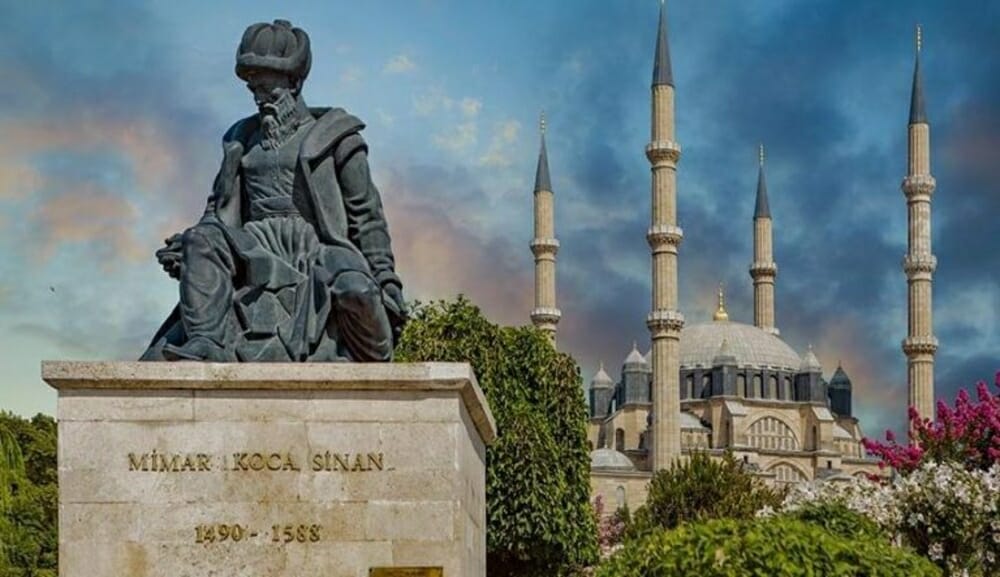
The most talked about work of Mimar Sinan is Edirne Selimiye Mosque, which he built when he was eighty years old. The dome of Selimiye Mosque has a deeper and wider structure than the dome of Hagia Sophia Mosque. Mimar Sinan has placed it on an octagonal body with a dome of thirty one and a half meters in diameter. Three people can climb to the three-balcony minarets of Selimiye Mosque at the same time without seeing each other. The construction of Selimiye Mosque took 7 years and it is among the most important works of Ottoman Architecture. Mimar Sinan explained that this work is a work of mastery and that he showed all his dexterity on this mosque. The Süleymaniye Mosque and Complex, consisting of eight separate buildings, has become the second largest university in Istanbul after Fatih Mosque. Mimar Sinan continued to make a name for himself with the works he gave right after he became the Chief Architect. These works are the Şehzadebaşı Mosque and Complex. There is also a tabhane, a soup kitchen, a caravanserai and a madrasa separated by a street inside the complex. In addition to all these, the Süleymaniye Mosque, one of the largest and most magnificent works he made, is his most well-known work in Istanbul. Mimar Sinan is also an urban planning expert. He first creates the environment of the works he will create, and then moves on to the construction phase. Sinan showed great success in site selection and placed his works in a suitable way around his environment.
40 Fountain Waters
During the reign of the Kanuni Sultan, Mimar Sinan was given a task to meet the water needs of Istanbul. In 1564, Sinan brought the water resources located outside the city together in the Kağıthane district as a result of a nine-year work, and made passages there and conveyed them to the whole of Istanbul. Thanks to the water resources in Kağıthane, public water distribution is provided to the people of Istanbul from 40 fountains. Thus, the water requirement problem was solved by Mimar Sinan. It is one of the greatest works of Sinan, which meets the needs of Istanbul with 40 fountains of water. This work is not well known because the units are formed from a very long distance and the structure cannot be seen as a whole with the naked eye. Known as the largest and most modern water transport facility of the period, forty fountain waters provided great benefits to the people of Istanbul.
Works
Mimar Sinan developed his art without imitating the same by seeing and examining all his works wherever he went. Examining the details in the works he saw, Sinan constantly improved and renewed his art and works. Walls, columns and other parts of Sinan did not make all his works out of thick measures. The great man, Mimar Sinan, developed himself by creating different and remarkable structures in his time, and provided great benefits to the Ottoman Empire. All the known works of Mimar Sinan, who made the stones talk with his art; 53 small mosques, 57 madrasahs, 84 mosques, 7 darülkurra, 17 soup kitchens, 22 tombs, 5 waterway arches, 8 bridges, 3 hospitals, 20 caravanserais, 48 baths, 8 cellars and 35 There are a number of palace artifacts. The works of Mimar Sinan, which have survived for years from the past to the present, show how resourceful, hardworking and forward-thinking he was. Those who examine the works of Mimar Sinan, who has many works, stated that he took all the known and necessary precautions against earthquakes in all of his works. The most important of Mimar Sinan’s importance is the mortar he used on the floor. When the works are compared, the earthquake risks are reduced thanks to this material, which is only seen in the works of Mimar Sinan. The location choices seen in the works of the period are also very interesting. Measures were taken to consolidate the ground of the work, the soil was compacted with piles and the abutment walls were built. One of the measures of Mimar Sinan, the construction of the Süleymaniye Mosque, was delayed for six years for the foundation to be laid. The main reason for waiting for the foundation is to ensure that the foundation is fully seated on the ground. Another type of building that Mimar Sinan made a name for is the tombs. A scientist still continues to make a name for himself by working meticulously.
His Most Important Works
- Apprenticeship Sehzade Mosque
- Masterpiece of Suleymaniye Mosque
- Masterpiece Selimiye Mosque
- Haseki Complex
- Mihrimah Sultan Mosque (Edirnekapi)
- Kilic Ali Pasha Mosque – Tophane
- Sokullu Mehmed Pasha Complex (Kadırga)
- Cihangir Mosque
- Rustem Pasha Mosque
- Old Valide Pasha Mosque
- Haseki Sultan Imaret- Mecca
- Haseki Sultan Imaret- Medina
- Sultan Süleyman Imaret- Süleymaniye
- Haseki Sultan Bath – Bahcekapi
- Atik Valide Sultan Hamam- Üsküdar
- Haseki Sultan Bath – Bahcekapi
- Hurrem Sultan Bath – Sultanahmet
- Rustem Pasha Madrasa – Fatih
- Sinan Pasha Mosque – Beşiktaş
- Rustem Pasha Mosque-Tekirdag
- Buyukcekmece Bridge
- Silivri Bridge
- Saray-ı Cedid-i Hümayun Repair –Topkapı
- Rustem Pasha Caravanserai – Rodoscuk
- Bend Belt – Kagithane