Tyana Ancient City
Geographical position
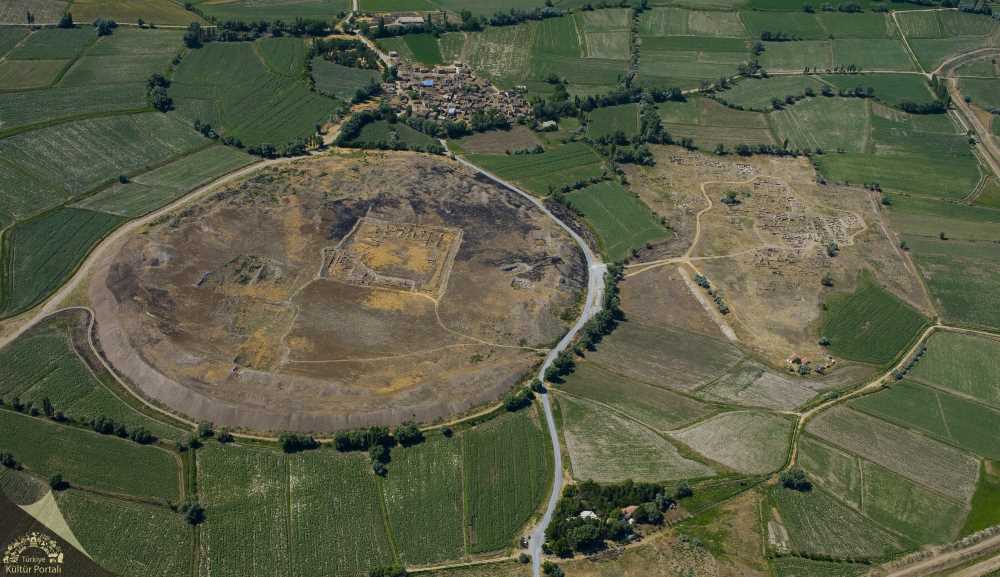
Tyana ancient city, also known as Tyana Ruins and Aqueducts Ancient Tyana ruins are in Kemerhisar Town of Bor district of Niğde. The ruins are under most of the town. Important sculptural works found in various parts of the town and works unearthed as a result of scientific excavations in the ruins are exhibited in the Niğde Museum.
Tyana Ancient City History
Kemerhisar is known as Tuwana during the Hittite period and as Tyana during the Roman period. The city, which served as the capital of the Southern Cappadocia Kingdom twice during the Roman period, also transports Anatolia to Mesopotamia. For this reason, it has had a strategic importance in every period. The ancient city is also known as the birthplace of the philosopher Apollonius. Excavations at Köşk Höyük near Tyana, 23 kilometers from the center of Niğde, take the region back to the Neolithic period. The name of the ancient city Tuwannuva was mentioned for the first time in the edicts of Telipnu, one of the Old Hittite Kings, between 1650 and 1540 BC. The mention of the ruler named Varpalava from Tuwana in the İvriz Rock Monument shows that Tuwana continued to exist in the Late Hittite Period and was among the most important Tabal Principalities in the period. The Greek historian Xenophpn described the city as big and rich in his work called Anabasis, and named it Dana. During the Hellenistic Period, the city of Tyana continued to be called by this name. After the death of Alexander, the city of Dana was included in the borders of the Kingdom of Cappadocia, among the kingdoms that emerged during the struggles of the generals. The city, which was located in the Kingdom of Cappadocia, which was a Roman province in 17 AD, began to be called Tyana, which was its original name in this period. During the Roman Period, Tyana experienced the most important and productive years in its history, with intense construction. During this period, it grew considerably with palaces, temples, aqueducts and settlements.
Tyana was an important religious center during the Pagan and Christian Roman periods. One of the reasons that made the city strategically important was that it was located on a historical road connecting Cilicia to Cappadocia. After the Byzantine Period, the city hosted many civilizations. The city, whose name was changed to Kilisehisar after it came under the domination of the Turks in 1077, took the name Kemerhisar due to the fact that it had aqueducts in the Republican Period. Tyana is also the St. It is also known as the city of Apollonius, the contemporary of Jesus. The story of Apollonius, who condemned animal sacrifices, did not eat meat, did not wear woolen clothes, and distributed all his wealth to the poor, is still circulating.
There are tombs in caves in volcanic formations in Tyana, as in the rest of Cappadocia. Limestones, marble and stone fragments are generally found among the building materials of the first settlement of the city of Jupiter and the remains found in the vicinity. It has been learned from written sources that these were obtained from lime, stone and marble quarries in or near the city.
Kemerhisar became an important religious center with the Jupiter temple, named after the nearby Amasbeen lake, and spread the Jupiter religion. One of the two lakes in this area has a bitter taste and the other one has a sweet taste. This situation caused the rumors about the temple to increase. At the end of the Roman period, Tyana also had an important place in terms of Christianity in Byzantium. The geographical location of Tyana also played a major role in making Tyana an important center in terms of religion. After the first age civilizations, Rome and Byzantium, an intense Arab and Turkish incursions were experienced in the region. Although all the people of Kemerhisar were Turkish and Turkmen peoples who were settled here by force, a significant number of Armenian and Greek peoples lived here with the Turks due to the rights granted to minorities in the Ottoman period.

Apollonius of Tyana
Apollonius of Tyana is a philosopher who was born in Tyana, in the city of Cappadocia of the Roman Empire, and stands out as one of the representatives of the new Pythagoreanism. When Apollonius was 16 years old, he passed from Tyana to Tarsus. He studied at the school of Pythagoras and traveled to different countries, becoming one of the advocates of the new Pythagorean ideas. He died in the city of Ephesus, where he founded a school. The philosopher Apollonius, who coincided with the mistake in the same period as Jesus, is also known as the principle vegetarian of history. Philostatus wrote the book The Life of Apollo of Tyana, describing the life of Apollonius after his death. His sources are thought to be between 170 and 180 years. Apollonius of Tyana is mentioned with names such as Balinas or Balinus in Islamic works.
One of the best known works about his life was written by the Sophist Filostratus at the request of Empress Julia Domna, the wife of Septimius Severus. Filostratus completed the work in the 230s, after the death of the empress. The book of Filostratus is one of the most important sources for future generations. There are also letters written to Apollonius in this work. The writings of Apollonius can also be found in this work. One of the sources Filostratus used while writing the book is the memories of Damis. Damis was Apollonius’ friend and assistant. Some experts say that Damis’ memories are fabricated. Filostratus tells that Apollonius was a traveling philosopher and accomplished miraculous works. Apollonius, who traveled to Italy, Spain, North Africa, Mesopotamia, India and Abyssinia, as well as Greece and Anatolia, lived a very wandering life. Filostratus also tells that he did not mind Emperor Nero’s prohibition of philosophers from entering Rome, and that after he entered the city, he was summoned to peace during the reign of Emperor Domitian and said harsh words to the emperor. At that time, Apollonius was accused of conspiring against the emperor, human sacrifice and predicting an epidemic by magic. Philostratus implies in his work that Apollonius of Tyana ascended to heaven after his death.
Experts differ in their belief in the writings of Filostratus. Some experts say that Apollonius never went to Western Europe and was not recognized until the 3rd century AD, Julia Domna from the Syrian province made him famous in the West. According to the same experts, Julia Domna had Philostratus write that Apollonius was a great sage with extraordinary powers and fearless even Pythagoras. The information supporting Julia Domna’s embrace of this purpose is that her son Caracalla worshiped Apollonius of Tyana. Alexander Severus, grandson of Julia Domna’s brother, also worshiped Severus of Tyana.
Apollonius of Tyana is known throughout his life as a documented sage. He has been described as God in the Image of Man for the hundred years he lived. The Catholic Church, which wanted to hide the works and name of Apollonius, who was thrown into the dungeons but did not compromise his views, could not reach its goal. Like all the new Pythagorean philosophers, Apollonius opposed sacrificing animals because he firmly believed that animals have a spirit transferred from God and that the spirit of the person in the body dominates that body. He brought vegetarianism to the fore in order not to take the spirit that resides in the animal and circulates in his blood, along with the edible animal meat. Apollonius of Tyana was the new Pythagorean and hermetist who had the secrets of numbers and geometry. During his long life, Apollonius did not establish an organization in his name. His greatest mission was to reach as many people as possible in today’s world, as understood from the documents and the books written. It was his greatest aim to enlighten people about wisdom and correct knowledge. Although Apollonius did not organize religiously, he had many followers wherever he went. The most well-known of these is Damis. The best-known works of Apollonius include works on talismans. In this work, microcosm and macrocosm, which are the basic principles of Hermetism, are handled. Another of his works is about astrology. This work consists of 6 volumes. In these books, Apollonius explains the connections of the stars through talismans. There are 70 talismans and 400 pictures in his book called Seven Planets and Talismans. How to use these talismans is also explained in the book. The Magick book also introduces Apollonius as a master of magic. Apollonius in many ways Hz. He is equated with Jesus.
Historical Artifacts in Tyana
Archaeological studies in Tyana began between 1986 and 1988. Archaeological studies continue to this day. Many historical artifacts and structures have been found in Tyana.
Baptistery and Church
The baptistery, one of the symbols of the city of Tyana, is located on the northeast slope of the city in the southeast – northwest direction and has a rectangular plan. There is an apse with five facades in the middle of the wall facing northeast. In the middle of the building, there is a one-piece bafitz boat made of white marble. About 15 meters southwest of the baptistery, there is a church with a three-nave basilica plan.
Aqueducts
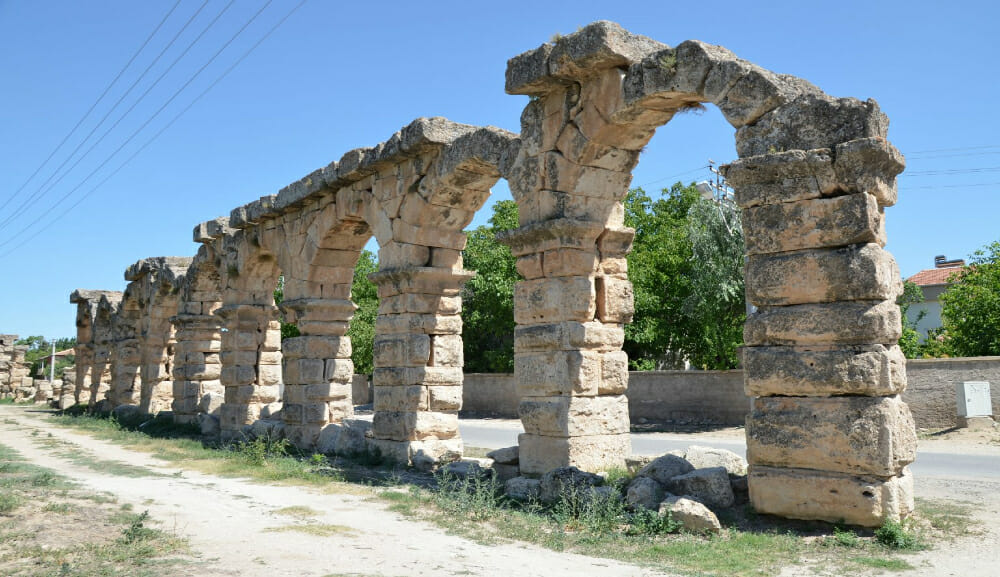
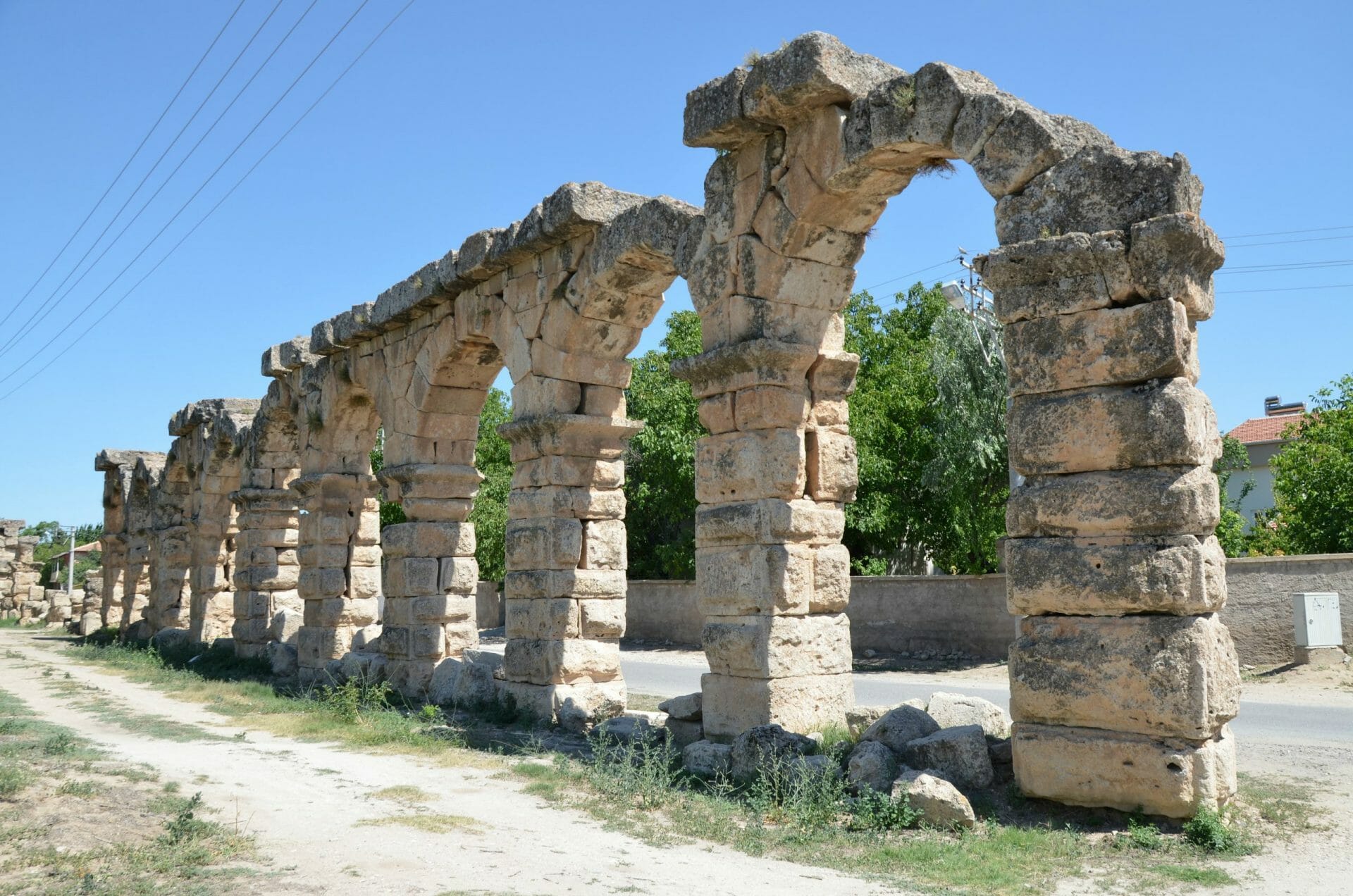
The pool and aqueduct line built to meet the water needs of the city of Tyana during the Roman Period is quite remarkable. The aqueducts, which were built in 98 AD during the time of the Roman Emperor Trajan, were completed during the reign of Emperor Hadrian. The aqueducts, which are about 6 meters high, were designed using the golden ratio in mathematics. It is also known that aqueducts meet the water needs of 30 thousand people. There is also a large and deep pool belonging to the Roman Period, 3 kilometers ahead of Tyana. Depending on the natural slope, the water collected in the pool was first transferred to underground canals and then to the city via aqueducts on the surface. The only relics that can be seen on the ground in Tyana are the aqueducts dating back to the 2nd – 3rd centuries AD, which gave the city its current name. The aqueducts, which are 1.7 kilometers long, consist of round arch openings. During the Roman periods when aqueducts were built, Tyana experienced the most important periods of its history with heavy construction
Roman Pool
The water collection areas are also called the Roman Pool. It is still active and is seen with the collection of natural spring waters. It was built in the Roman period with the purpose of carrying water to the ancient city of Tyana, with underground canals and aqueducts made according to the situation of the region. The pool was built in olympic dimensions. Today, water channels are underground from the Roman Pool to the interior of Kemerhisar. The 1200-meter parts of the arches could be protected up to 6 meters. Coins belonging to the period of Emperor Caracalla were found at the starting points of the channels coming out of the reservoir, and it was understood that the pool was built between the 2nd and 3rd centuries.